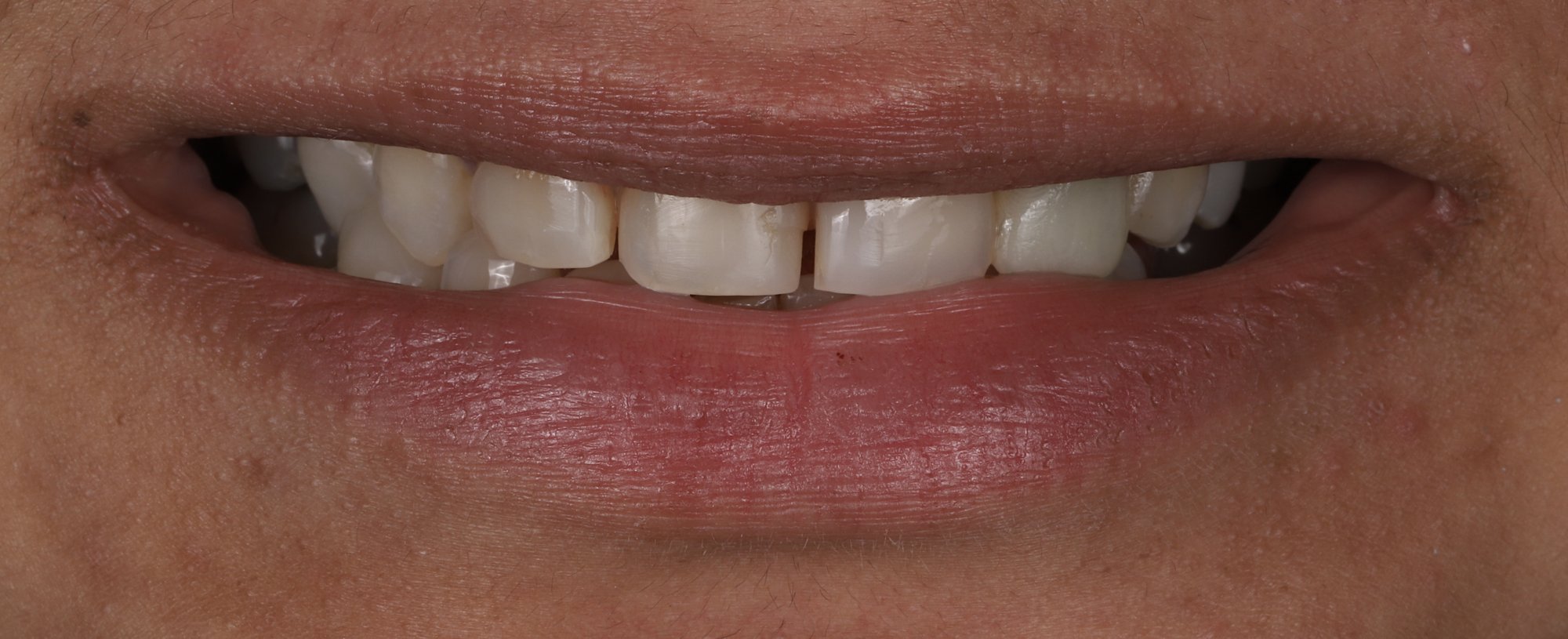
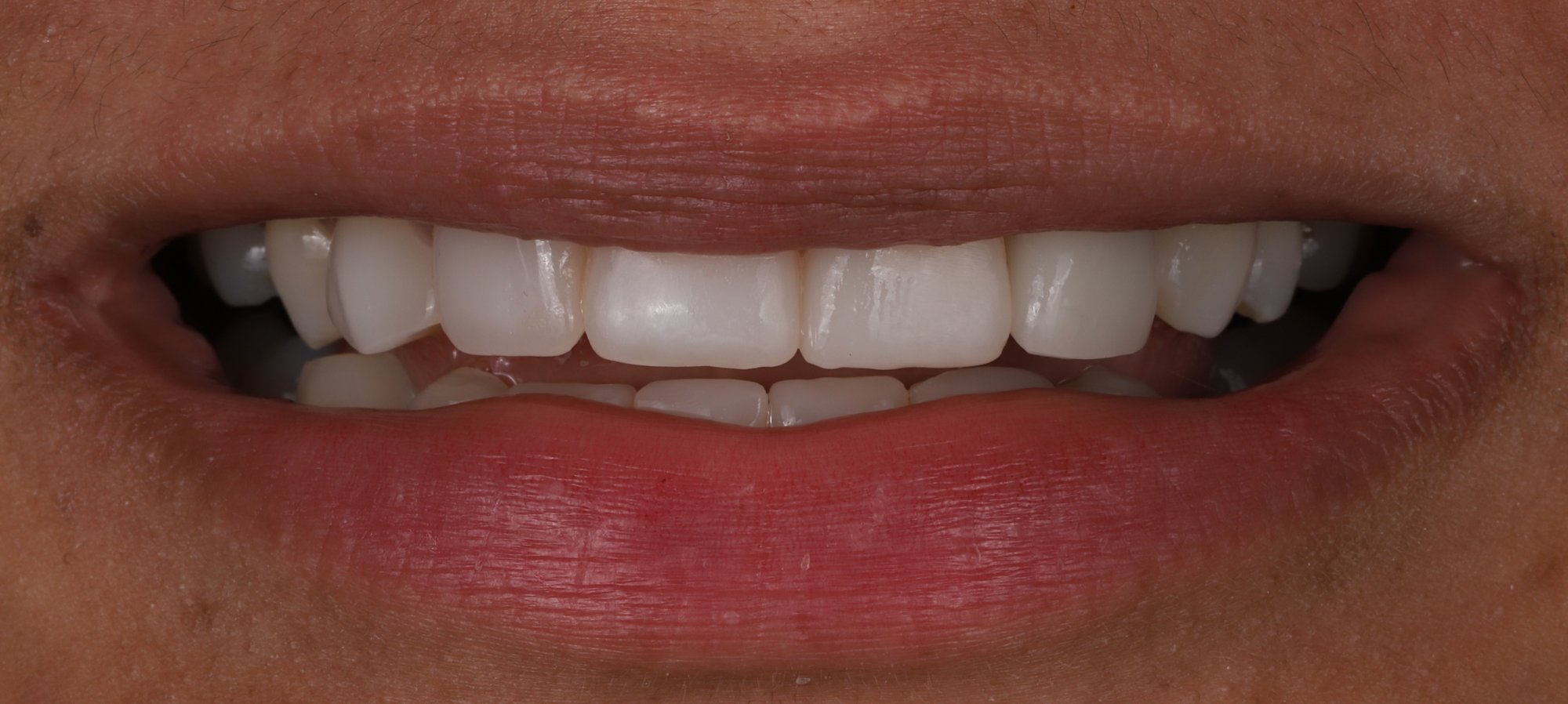
Traditional veneers require reducing your tooth to make room for the porcelain. No-prep veneers are thin enough to bond onto the front of your natural tooth with little or no reduction — preserving enamel and leaving future options open.
No-prep veneers are ultra-thin porcelain-like shells — about the thickness of a contact lens — that bond directly to your existing toothh surface. Because they're so thin, most cases require little or no tooth reduction.
The upside is real: you preserve your natural enamel, and if you ever want to remove them, you can. The downside is they're only appropriate for certain cases. They can't correct severely discolored teeth (the old tooth shows through), and they can't move teeth forward if your smile is already too prominent.
At consultation, we'll tell you honestly whether you're a candidate. We don't upsell. If traditional veneers are the better answer for your case, we'll tell you that.
The ideal no-prep candidate has small-to-normal teeth, minimal spacing, and a tooth shade that doesn't need heavy masking.
If your teeth are smaller than average or set back slightly, no-prep veneers can add volume without looking bulky.
Small cosmetic corrections — edge chips, slight shape irregularities, minor spacing — are ideal for no-prep.
If you want the option to remove veneers someday, no-prep is the safer bet. Traditional prep is permanent.
With no drilling, the process is faster and involves no temporaries.
Photos, intraoral scan, and Exocad smile design. We verify you're a no-prep candidate — not every case is.
We design your veneers in CAD and 3D-print them in-house using a ceramic-filled translucent resin on our Midas printer. We can print as thin as 0.2mm to minimize bulk. Many cases can be delivered the same day; complex cases may take a few days.
No anesthesia needed (nothing is drilled). Teeth are cleaned and etched, veneers are bonded one at a time under magnification.
A conservative case showing what no-prep veneers do best — restoring proportion, edge detail, and brightness by adding porcelain to the natural tooth. No drilling. No anesthesia. The teeth underneath are still intact.
Simple and flat: $800 per tooth. We usually recommend 6 veneers as a minimum, 8 if your smile shows more teeth, and 10 for wider smiles. You'll know exactly what your case costs before we start.
Dr. Jay Siddiqui personally evaluates every case. No associates, no rotating doctors. Book online or call to schedule — evenings and Saturdays available.